Esztergom has been inhabited since prehistoric times and reached its golden age in the Middle Ages. The area known today as Víziváros, where the mosque stands, was already one of the most important parts of the city. Its name was inspired by the two branches of the Danube and the warm-water springs that emerged here.
The fate of the city changed in 1543, when the army of Sultan Suleiman the Magnificent captured Esztergom. The city became part of the Budin (Buda) Vilayet and remained alternately in Ottoman and Christian hands for 130 years. During this period, the image of Ottoman Esztergom took shape: baths, mosques, madrasas, and bastions were built — among which the Özicseli Hadzsi Ibrahim Mosque is the only one that has survived partly in its original form.
The builder of the mosque was Özicseli Hadzsi Ibrahim, who was among the believers who had completed the pilgrimage to Mecca — indicated by the honorific “Hadzsi”. The famous Ottoman traveler Evliya Çelebi described the building in 1663 as follows:
“The mosque of Özicseli Hadzsi Ibrahim is covered with lead, has a painted wooden ceiling, a large interior space, a brick minaret, and is tall, newly built, and beautiful.”
From his description we know that the prayer house included a dervish lodge (tekke) and a school (madrasa), making the mosque not only a religious but also a community center.
After the recapture of the city, the archbishopric used the building as a granary, as seen on the military engineer Krey’s map (1756). Later, the mosque served as a residential building until the archaeological excavations, during which this unique Ottoman monument was rediscovered and saved.
About the Exhibition
Today, the mosque welcomes visitors as a museum and exhibition space, where they can learn about the world of Islamic culture and religion — with a special focus on the Ottoman era of Esztergom. On the lower level, an interactive exhibition presents the everyday life of Islamic society:
- Clothing and traditions
- Arabic writing and calligraphy
- Burial customs
- Forbidden and permitted foods (halal–haram culture)
One of the highlights of the exhibition is a sound dome, where visitors can listen to Evliya Çelebi’s 17th-century account of his visit to Esztergom — thus they can “travel back in time” through his voice.
In the gallery level, objects from the Ottoman period found in the Esztergom area are on display.
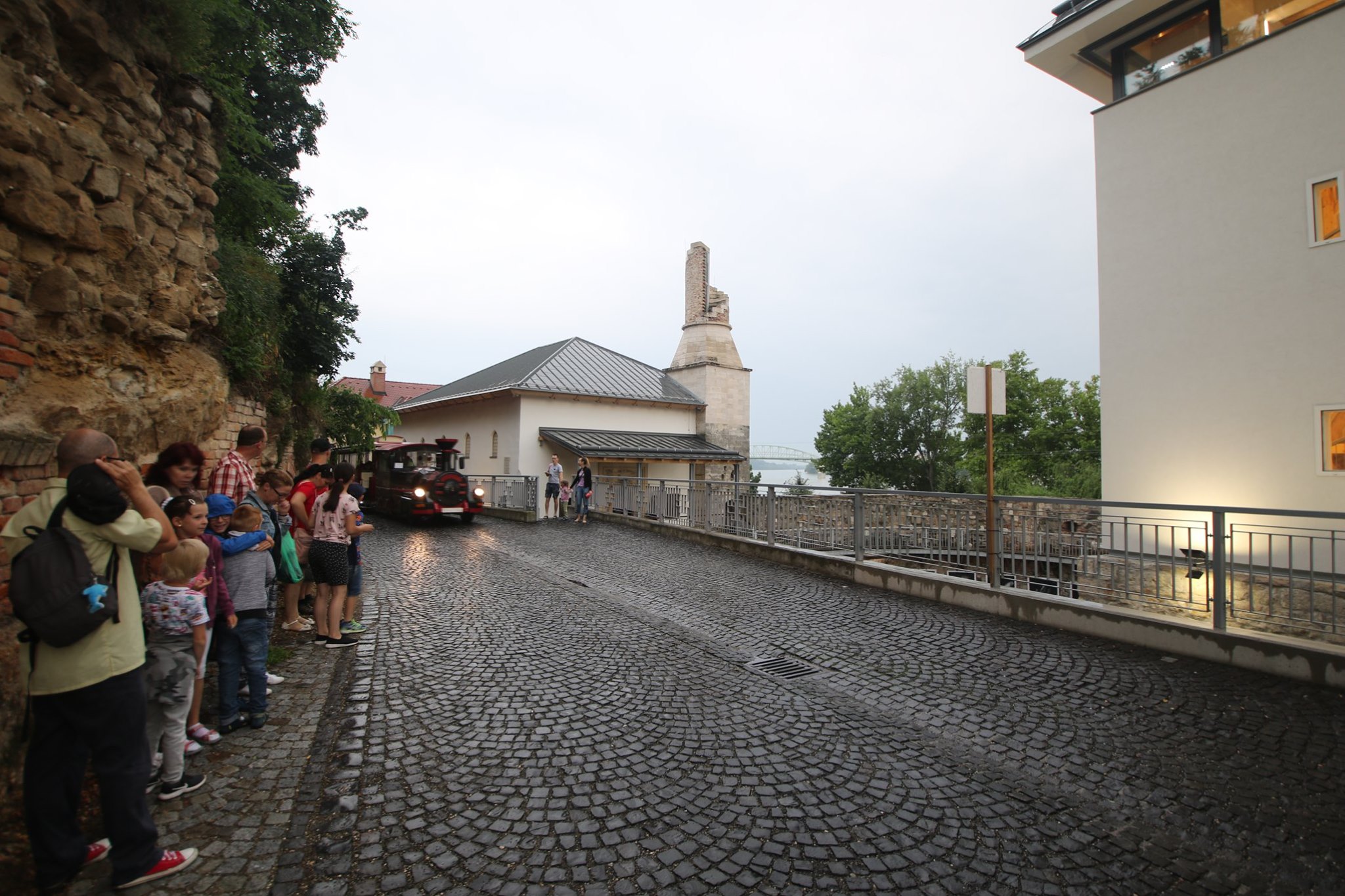
The bravest visitors can climb the narrow spiral staircase of the minaret to reach the top of the tower, where breathtaking views open over Víziváros and the Danube.
The exhibition is free to visit and available periodically until the middle of next year. It offers a unique opportunity for visitors to experience the world of Ottoman-era Esztergom up close — where history, religion, and culture come together.